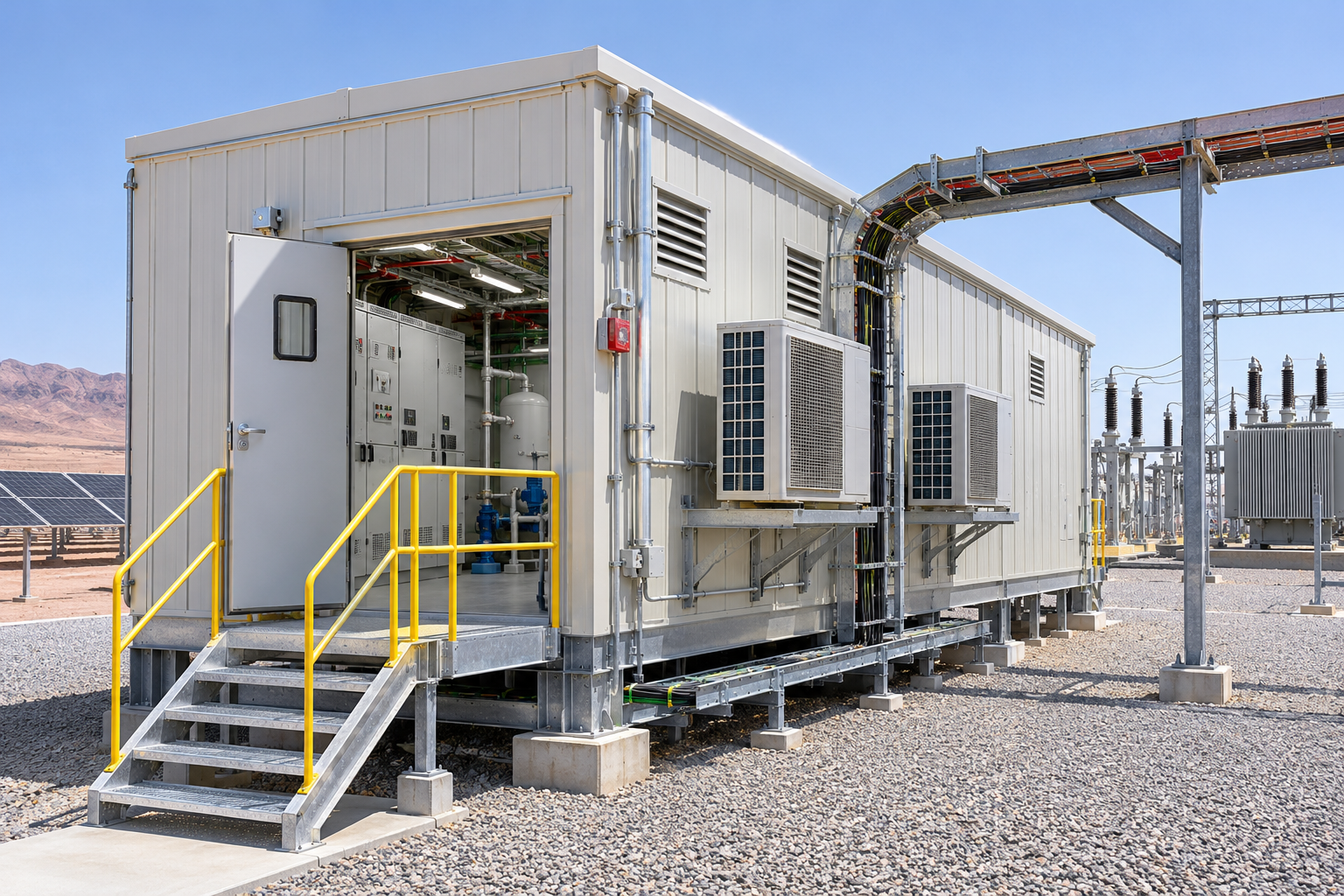
Remote mines, renewable plants, oil and gas facilities and infrastructure projects often face limited skilled labor, difficult weather and compressed construction schedules. A prefabricated E-House moves much of the equipment installation, wiring and functional testing into a controlled factory environment.
The module may contain medium- and low-voltage switchgear, protection panels, control systems, UPS and DC supplies, communications, HVAC and auxiliary services. Its value comes from complete integration rather than from the enclosure alone.
Design the Module for Its Destination
Ambient temperature, solar load, dust, humidity, corrosion, altitude and seismic duty affect insulation, cooling and structural design. HVAC capacity should include equipment losses, occupancy, solar gain, filter loading and degraded operating modes.
Transport can impose stricter limits than operation. Module dimensions, mass, lifting points, split lines and internal bracing must suit the road, rail or marine route and the cranes available at site.
Interfaces That Need Early Agreement
Incoming and outgoing power cables, bus ducts and transformer connections.
External grounding, lightning protection and bonding of removable sections.
Control, fiber-optic, fire-alarm and plant-communication interfaces.
Auxiliary power, backup power, HVAC, lighting and emergency systems.
Foundation, access stairs, platforms, doors, escape paths and maintenance clearances.
Site assembly sequence, weather sealing and re-test requirements after transport.
Factory Integration Changes the Test Strategy
A full factory-acceptance test can verify protection logic, interlocks, SCADA points, alarms, HVAC controls, UPS autonomy and sequence-of-operation before the module leaves the factory. Customers should define the test scripts and witness requirements early.
After delivery, site testing confirms transport integrity, cable connections, grounding and interfaces to field equipment. Clear boundaries between factory and site responsibilities reduce duplicated work and commissioning gaps.
Next Step
For integrated medium- and low-voltage distribution, review SOVIN’s secondary unit substation and discuss whether a compact outdoor package or a larger E-House arrangement better fits the project.
Technical reference: project-specific IEC, IEEE/ANSI, structural, fire-safety and environmental requirements.
Angesichts der rasanten Entwicklung der Photovoltaik-Technologie haben Perowskit-Solarzellen (PSCs) mit hohem Wirkungsgrad und niedrigen Kosten große Aufmerksamkeit auf sich gezogen, da sie das Potenzial haben, herkömmliche kristalline Siliziumzellen zu ersetzen. Insbesondere flexible...
A dry-type transformer may be rated correctly on paper and still run hotter than expected when the surrounding electrical room cannot remove its losses. Continuous loading, electronic equipment, high ambient temperature and restricted airflow can ...
Der weltweite Strombedarf steigt in den Jahren 2026–2027 rasant an. Erfahren Sie, warum der Wirkungsgrad von Transformatoren, die Netzkapazität, eine frühzeitige Spezifikation und eine koordinierte Planung der Schaltanlagen für neue Energieprojekte von Bedeutung sind.
Artificial intelligence is moving from pilot projects into practical grid operations. The International Energy Agency’s September 2026 report Modernising Grids in the Age of Electricity says digital tools can improve forecasting, optimisation, sit...
 Ausgewählte Kategorien











Produktanfrage senden
Wir werden uns innerhalb von 24 Stunden bei Ihnen melden.