Artificial intelligence is moving from pilot projects into practical grid operations. The International Energy Agency’s September 2026 report Modernising Grids in the Age of Electricity says digital tools can improve forecasting, optimisation, situational awareness, resilience and risk management across transmission and distribution networks.
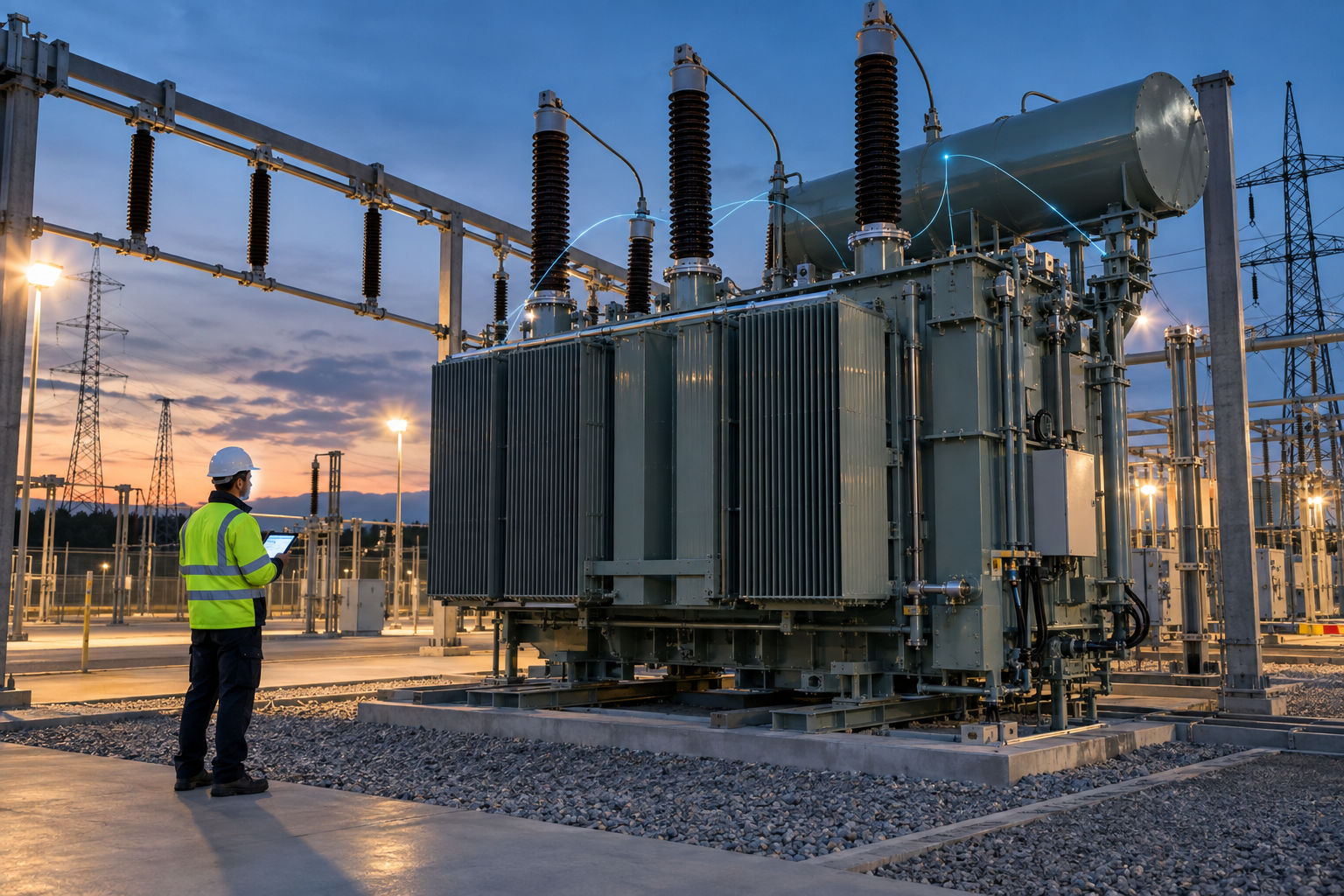
For transformer projects, the important change is not simply adding more sensors. Utilities and industrial operators need monitoring systems that turn temperature, load, cooling and condition data into decisions that protect equipment life while making better use of available capacity.
Why Digital Grid Operations Matter
Electricity networks are carrying more variable renewable generation, battery storage and concentrated loads such as data centres and fast-charging hubs. These conditions create faster changes in loading and power flow than many traditional planning assumptions anticipated. Better visibility helps operators distinguish between a temporary peak, a developing cooling problem and a sustained capacity constraint.
AI-enhanced applications can support load forecasting, anomaly detection and maintenance prioritisation, but their results depend on reliable field data. Transformer monitoring therefore remains the foundation: oil and winding temperature, ambient temperature, load current, cooling-system status, dissolved-gas data where required, and alarms must be accurate and time-synchronised.
Five Requirements to Define Early
Sensor scope: specify the measurements needed for thermal, electrical and mechanical condition assessment instead of adding instruments without a clear operating purpose.
Data quality: define accuracy, sampling interval, time stamping, data retention and rules for missing or abnormal readings.
Communications: agree protocols, interfaces, network architecture and responsibility for integration with SCADA, a historian or an asset-management platform.
Alarm ownership: set warning and trip thresholds, escalation procedures and the person or team responsible for each response.
Cybersecurity: treat connected monitoring equipment as part of the operational-technology environment, with controlled access and maintained firmware.
Monitoring Must Match the Transformer Design
A useful analytics platform cannot compensate for a thermal model that does not match the transformer construction, cooling method or insulation system. Nameplate ratings, temperature-rise limits, impedance, tap range, loss guarantees and cooling stages should be linked to the monitoring configuration during engineering review.
For oil-immersed transformers, projects may also consider oil-level indication, pressure protection, dissolved-gas monitoring and fan or pump status. Dry-type units may require winding-temperature sensors, ventilation status and environmental monitoring for dust, moisture or high ambient temperature. The appropriate package depends on criticality and operating conditions.
From More Data to Better Decisions
The goal is not to collect the largest possible volume of data. It is to detect abnormal behaviour earlier, prioritise maintenance and understand the margin between actual loading and safe operating limits. Projects should begin with a clear decision framework, then select sensors, communications and analytics that support it.
Grid connection queues are becoming a central issue for power-system developers. The International Energy Agency’s Electricity 2026 report says more than 2,500 GW of renewable generation, storage and large-load projects are waiting in connection q...
Distribution-transformer efficiency, manufacturing capacity and material availability are again under review in the United States. In June 2026, the U.S. Department of Energy issued a request for information on how energy-conservation standards fo...
Angesichts der rasanten Entwicklung der Photovoltaik-Technologie haben Perowskit-Solarzellen (PSCs) mit hohem Wirkungsgrad und niedrigen Kosten große Aufmerksamkeit auf sich gezogen, da sie das Potenzial haben, herkömmliche kristalline Siliziumzellen zu ersetzen. Insbesondere flexible...
Aus den vom Ministerium für Industrie und Informationstechnologie veröffentlichten Daten geht hervor, dass die Produktion in allen Bereichen der Photovoltaik-Wertschöpfungskette im Jahr 2022 ein Rekordhoch erreichte. Die Produktion von Polysilizium, Siliziumwafern, Zellen und Modulen in China erreichte...
 Ausgewählte Kategorien










Produktanfrage senden
Wir werden uns innerhalb von 24 Stunden bei Ihnen melden.